The Donns of Ducksie Part 2
Recorded 9 months ago

 About this recording
Jim Shankland's maternal great, great grandparents, John and Catherine Donn moved from Guidebest, Latheron to Grant Street (Ducksie), Pulteneytown.
One element of Jim's extensive family history focusses on The Donns of Ducksie. With the assistance of his son James Donn Shankland as narrator, the story of The Donns of Ducksie has been recorded.
Jim's research is supported by extracts from the John O'Groat Journal, recorded by Ian Leith. As well as writing the script, Jim provides an audio introduction to part 1 and conclusion to part 2.
The recording is in two parts:
Part 2 focusses on the fascinating story of William Donn’s relationship with Helen Gray and their child John.
Part 1 tells the compelling tale of John Donn & Catherine Sutherland.
Script Part 2
Principal Narrator – JDS: James Donn Shankland
John O’Groat extracts - IL: Ian Leith
Introduction and end paragraph - JS: Jim Shankland
CAPITALS– to aid phonetic pronunciation
Narrator JDS begin second part
PART 2
Now returning to the story of William Donn’s relationship with Helen Gray and their child John, as 1866 drew to a close we can only speculate how John and Catherine celebrated Hogmanay looking ahead to what 1867 might bring. Helen Gray and her son John approaching his third birthday, mother and toddler would have been a familiar sight around town. By then, in that close community it must have been common knowledge that William Donn was the child’s father. Even the local gossips would have known the circumstances. A Paternity Action raised by Helen was heard at the local Sheriff Court on 28th January 1867.
Fortunately the paper document recording the decision of the Court Action came down through the subsequent generations of young John’s family and this confirmed the child’s parents were Helen Gray and William Donn.
The Sheriff’s decision permitted the Registrar for Births, Deaths and Marriages to ‘correct’ the form ‘Birth Certificate Information.’ Accordingly the name Donn could be added to John George Gray. The decree confirms father William’s trade as connected to the local fishing industry and also gives his address as Grant Street.
Why William, by then commonly known to be the father of John was not recorded in his son’s original birth certificate is unknown. Given the subsequent sheriff’s decree would it be correct to conclude William did not want to acknowledge his parenthood and to face local scandal?
There is no indication anywhere in written or oral record that William (or his parents John & Catherine) contested the paternity decision. Unfortunately from 1860 to about 1900 most Court Case records of this nature have been destroyed and so an irrefutable formal explanation is unavailable. At least the original paper birth certificate survives and also the Sheriff’s Decree and Corrected Birth Certificate substantiate William as John George Gray’s father.
It seems doubtful that a young woman alone would pursue this course, engaging with legal process, without the support of others? Helen Gray’s legal action did ensure the identity of her son’s father was confirmed. Significantly by subsequent events it is known young John was welcome within the circle of the Donn family.
Is there an explanation for there being no record of parents, Helen and William living together, under one roof even although both families wanted to acknowledge the child? By the time of the Paternity Action in January 1867 it was absolutely apparent William and Helen would not be getting married.
So what more can be gleaned of William’s whereabouts. To recap, he is found in the 1851 Census shown age 10, living in Grant Street with his parents. After the 1851 census no reference to William Donn can be found in any of Scotland’s Registers except the 1867 court decree.
It seems very unlikely William was ‘hidden in plain sight’ and all the while living around Wick.’ Perhaps William’s skill as a ships carpenter led him south to England or overseas never to return. William could have simply absconded. Though there is a marine register for people ‘lost at sea’ this is incomplete and unless appearing in press articles men from fishing communities such as Wick, having gone missing, presumed drowned, their bodies frequently never recovered, names were not recorded.
All this circumstantial evidence, the sequence of events, suggests that something unexpected intervened in the relationship between Helen and William and his apparent disappearance. The most convincing explanation is that during Helen’s pregnancy William was lost at sea.
This tragedy must have occurred before John’s birth in January 1864, perhaps during a storm or accident at sea the preceding year. Why else would the father’s name remain blank but the baby being named after his grandfather John, why else no marriage certificate and why else the ready acknowledgement and acceptance of young John by his grandparents and the extended Donn family, the relationships continuing for many years into the subsequent generations.
Tragically, taken by the sea there was no burial and no formal proof of William’s death. This is surely the answer.
My great grandfather Robert, ten years younger than his brother William later married and one of his sons, my grandfather was named William. One of the reasons for this naming must have been a note of affection by Robert in remembrance of his elder sibling. This is a nod in favour of William’s character and the esteem held for his brother Robert.
Here’s how I first tumbled upon the tale of William and Helen and how the tangled science of DNA matching, this tale of blood knots helped me tell the story of John George Gray Don, the child born out of wedlock whose Dad had died at sea.
I got my DNA analysed and contacted a distant cousin with 2% shared DNA which indicated a more distant ‘bloodline’ possibly from several generations ago. I met Richard Patrick, a nephew of this distant cousin and he showed me the family tree down from his great grandfather John George Gray Don, the son of William and the brother of my great grandfather Robert.
There is a photograph of our Wick family featuring my great grandfather Robert, taken in 1883 or 1885, taken possibly when he travelled from Govan to attend his mother or father’s funeral. This photo of Robert bears a striking likeness to a photo taken in Glasgow in 1891 of great grandfather Robert with his wife Jane and their five children. Blood knots can be a complicated story and thanks to DNA and Richard Patrick the story of William and Helen and their son John can now be told.
IL narrator begins second section
START CAITHNESS NARRATION 2
Just three months after the paternity case John faced further tumult. The John O’Groat Journal at Wick on 30 May 1867 contains the Report of John Donn, Master of The Express. ‘The Express was wrecked at Holm, as previously reported. The following is John’s official report:-
The Express of Wick, 27 tons was from Pulteneytown to Holm with 140 barrels of salt, about fifteen and a half tons, and 195 empty barrels:- Left Pulteneytown May 9 and made Cape Wrath at about 8 A.M. on 10th, wind E. About noon it became dense with fog and at 12 P.M., wind E.N.E., light, struck on a reef of rocks near the said place off Holm HAWLM, in the port of Stornoway, where she now lies in a disabled and dangerous position, from the sharpness of the rocks and the heavy swell of the seas, which lift her up and down on the rocks. I believe she will become a total wreck. At present the keel stern and stern post are broken out, the keel being alongside. Prior to the high water at noon, on 11th, I engaged two men to assist in getting the smack off but without success.’
In the event John Donn was able to recover his vessel from the reef lying near Stornoway, to then salvage and repair ‘The Express’ and within a short period he had resumed his business activities.
The John O’Groat published 21st May 1868 listed Sailings including on 18th May 1868, the ‘Express, Donn, Stornoway, stock.’ John had voyaged once more in sight of the reef where his stricken vessel had recently foundered. Here’s a man who faced adversity, overcame set-backs, reset his compass and found his way forward. John was adaptable and just one of his skills must have been working with others whatever their capacity or role.
John’s father and many in his wider family had spoken Gaelic. John had spoken both languages from childhood days in Latheron and switching between the Caithness CAITNIS dialect and Gaelic and speaking formal English would have been useful when Gaelic was then still a common tongue in these lands and amongst the communities of fishermen.
JDS Narrator
Later that year in September 1868, the Scottish author Robert Louis LEWIS Stevenson then age seventeen was sent to Wick for six weeks work experience. The son of the famous lighthouse and marine engineering Stevenson family his father had found Robert Board and Lodgings in the New Harbour Hotel, Harbour Terrace and arranged training with engineers and divers constructing the new breakwater. Unfortunately this project turned out an abject failure unable to withstand the storm forces of the sea. For the duration of his stay, the weather was persistently dreadful, windy with drenching rain and intermittent tempests driving huge waves from the open ocean into Wick Bay. Here’s extracts from his letters to mother and family.
JDS next paras is Robert ‘Lewis’ Stevenson voice
“Wick lies at the end or elbow of an open triangular bay, hemmed on either side by shores, either cliff or steep earth-bank, of no great height….about six sevenths of the way down-that the new breakwater extends athwart the bay.”
RLS continues “Certainly Wick itself possesses no beauty: bare grey shores, grim grey houses, grim grey sea; not even a gleam of red tiles; not even the greenness of a tree. The southern heights, when I came here, were black with people, fishers waiting on wind and night….the Wick men stay indoors or wrangle on the quays with dissatisfied fish-curers, knee high in brine, mud and herring refuse. The day when the boats put out to go home to the Hebrides, the girl here told me there was ‘a black wind’; and on going out, I found the epithet as justifiable as it was picturesque. A cold BLACK southerly wind, with occasional rising showers of rain; it was a fine sight to see the boats beat out a-teeth of it.”
To the south, however, is as fine a piece of coast scenery as I ever saw. Great black chasms, huge black cliffs, rugged and over-hung gullies, natural arches and deep green pools below them, almost too deep to let you see the gleam of sand among the darker weed: there are caves too…”
JDS voice
One Sunday he visited friends of his parents, Hamilton Russell who was the serving Sheriff of Caithness CAITNIS, his wife Margaret and their two daughters.
Here’s the thing. It was this Sheriff Hamilton Russell who heard Helen Gray’s Paternity Action in January of the previous year 1867. The Sheriff lived in Breadalbane Terrace just steps away from the homes of Helen Gray, the single mother with her child John and the Donns in ‘Ducksie.’ Round the corner from ‘Ducksie,’ the Sheriff’s house at Breadalbane Terrace was a step above the standard fishing village dwelling, a grander home set back from the public thoroughfare with an ornate iron fence set upon a low stone wall and a tidy front garden.
Before the Action was raised most likely Hamilton Russell was fully acquainted with Helen’s circumstances. Quite likely ‘as men of standing’ in the community John Donn knew Sheriff Hamilton. They could even have been acquainted as Kirk Elders. It’s even possible, with his ‘legal mind,’ that Sheriff Hamilton Russell had contrived the formal Action to confirm the child’s paternity and guided Helen and the Donn family towards this recourse. In the event the formal decree ‘drew a line’ under the matter, resolved any ‘moral’ issues, quashed any gossipmongers ONE WORD and at a practical level, aided Helen, the Gray and Donn family’s to ‘pull together’ in supporting the child.
Meantime John Donn’s shipping business continued. On 6th August The John O’Groat Journal listed John’s return to Wick under the newspaper heading Arrivals 30th July – Express - Donn – Easdale - slates.’
Easdale is a small island situated close to the Argyllshire coast south of Oban and across from the south coast of the Isle of Mull. The Easdale and the nearby Insh Slate Islands were the source of vast quantities of roofing slates. The workers lived almost troglodyte existences, burrowing out quarries into the core of land adjacent and in places beneath sea level. Eventually the quarries were overwhelmed and flooded in great sea storms. John would have looked upon this extraordinary landscape, an industrial scar amidst a beautiful land and seascape; but also observing a tight community digging out their livelihoods.
John started out from Wick by sailing the Pentland Firth known to some as ‘Hellsmouth’ infamous for its dangerous ‘grounds,’ fearsome rip tides and whirlpools along the passage to Cape Wrath. At this turning point John would have headed south through the Minch the sea strait between the Hebridean Isles and the mainland, also a challenging passage with Storm Force conditions sometimes even in Summer months.
The boat’s hold loaded at Easdale with valuable slates, he possibly sailed the safer return passage under contract to deliver the cargo, paying the transit fees, assisted by the prevailing westerly winds through the Caledonian Canal. Entering the canal system near Fort William ascending the locks known as ‘Neptunes Steps’ then via lochs interconnected by canals, emerging at the Port of Inverness John then headed north to his home port.
On October 21st 1869 the John O’Groat Journal reported amongst several Breaches of the Peace, –
‘A young lad named Donn was charged with committing a breach of the peace at the South Quay of Pulteney Harbour on 30th August. Having pled guilty he was sentenced to pay a fine of 20/- (£1) or to go to jail for ten days.
The fine was paid. Though the lad is not named the culprit was probably my great grandfather Robert then aged 20. No other details of the incident are provided. I suspect it was a case of youthful whisky fuelled revelling or brawling.
By the 1871 Census the household has moved, once again along Grant Street to no.43. John and wife Catherine, both aged 55. The children recorded at home are Robert 22 and James 20. Robert is recorded as a carpenter, learning the craft of building the herring boats. In my family’s oral history it was said Robert became apprenticed then qualified as a shipwright or journeyman, a skilled ship builder. Journeymen were fully qualified tradesmen who had served an apprenticeship. Usually they were employed by the day and paid a daily rate rather than being a “master” who would be self-employed.
Narrator IL section 3
In the Spring of 1872 John Donn was party to a sea rescue and the following is a report excerpt. The John O’Groat Journal – Wick, May 30, 1872 headline read:
Distressing Accident – Two Pilots Drowned
A very distressing boat accident happened about three miles off Boat-haven, in this neighbourhood, on the forenoon Tuesday last. Early in the morning, Four Pilot Row fishermen, named Peter Anderson, George Bain, John Anderson and George Manson put off in a boat to put a pilot on board a vessel that was sailing for the Pentland Firth. The vessel having been reached John Anderson was put on board and the three other men prepared to return to the shore. They were several miles out to sea, but the weather was fine and no one could have dreamed that there was any danger of an accident happening.
After sailing for some time on their way back, however, a heavy sea struck the boat and drove her on her side. George Bain who was steering, almost instantly disappeared in the water and was not seen again by his companions…A fishing boat was observed a good way off and Manson made signals which were noticed and they immediately bore down with all speed to the scene of the accident. The fishing boat belonged to James Small, Pulteneytown who was not on board but the crew exerted themselves to the utmost to save the drowning men….Anderson was seen still clinging to the bow, but it is believed by that time he was lifeless. A boat-hook was fastened to his clothing, and in dragging him off the wreck the hold of his clothing gave way and he sank into the water and was seen no more…nor that of George Bain.
All the attention that was possible in the circumstances was paid to Manson, the only one saved…Great praise is due to Small’s crew for their exertions on the occasion. Their names are Francis Bremner, William Wares, Murdo Rosie, John Donn, Alex MacDonald, Andrew Sutherland and David Rosie, cooper, who had taken the place for the day for one of the men who was absent.
Just over two months later the John O’Groat Journal 18 July 1872 reported on the inaugural Wick Regatta
'A regatta simply means a contest and comes from the name given to the gondola races which came off between the Venetian gondoliers in the grand old days of the Doges.’ The Pulteneytown Lodge of Free Templars organised the race and offered three prizes for a four yawl race in Wick Bay. A yawl is a two masted sailing boat. ‘A large concourse of spectators thronged the Braeheads and the old and new piers all eager to witness a contest so entirely novel in the locality. There was very little wind and the water was comparatively smooth.
From the mouth of the harbour - the distance of the course to the ‘flagboat’ stationed between the north and south heads was about a mile. The whole distance from the starting point to the ‘flagboat’ and back was thus two miles.’
‘At a signal when every oar was in the water the struggle among the rival crews commenced. The relative positions of the boats were eagerly watched by the crowd and a remark dropped now and again indicated that slight bets – sometimes a bottle of whisky, the Templars will be sorry to learn – were pending on the event. As the six boats neared the goal it became evident that the red flag would make a good first, that the blue and white flag was good for second and that the white flag would be third.’ Robert Donn shared the 3rd Prize – A Portmanteau – value 10/- (50p) – the crew Smith Miller, Thomas Murray, James Harper, Robert Donn, Leslie Christie.’
A Portmanteau is a large travelling bag – who knows the crew may have drawn lots for the bag and just maybe Robert won and this was used when shortly thereafter, later 1872 or early 1873 age 23 he departed Wick to make his life in Glasgow. Elsewhere the John O’Groat newspaper reported the Inverness to Wick railway is rapidly advancing.
By 1882 the Clyth Estate in Latheron Parish was said to be the most severely rack-rented in Caithness. This culminated in a crofter’s rent strike that was included in the Napier Commission’s Inquiry into crofter’s conditions.
“Magnus Sinclair a farmer from Clyth, in his statement to the Napier Commission, summed up very simply “What we want is our holdings valued by competent local judges, compensation for improvements, and that the land of our country be given to its people to live on at a fair rent.” The words “land of our country” bears the sentiment that the land is for the community and not the individual, something rooted from ancient times.
The John O’Groat Journal reported
‘Seldom, if ever, in this part of the country has there been such a unanimous burst of enthusiasm in connection with any political event.’ The largest group to march was that of the crofters, led by ‘the men of Clyth’ who ‘turned out to a man.’ They carried banners with the slogans ‘Clyth Forever’; ‘The Clyth Men are Enemies of Tyrants’; ‘The Lords should Emigrate to the North Pole, as People can do Without Them’ and ‘Clyth Soil for Clyth People’.”
These banners signified the mood was far from despondent, more like a community very much together, not just defiant but with a strong sense of purpose that whatever was put in their way, they’d come through adversity.
Imagine the crowd, the noise of all these voices, the chanting and singing, the sound of bagpipes and possibly the beat of a drum, the excitement of this extraordinary moment. Those of my forebears, by then residents of Wick, almost certainly mingled with family relatives, uncles, brothers and nephews still rooted in the district of Clyth, the men side by side in the demonstration march. Food tables set up outside for the marchers and their womenfolk with bread, mutton and herring. The older children would have helped whilst the young ran noisily about amongst the adults and stalls excited by this extraordinary scene. The atmosphere might have been like a Gala Day. Afterwards the inevitable return to the daily humdrum of life and in time the realisation that nothing much had changed.
JDS - final section of story
Here’s a story my mother Nancy’s told - she said we had dug ditches in Caithness and this had assisted her grandfather Robert find work in Glasgow. Apparently Robert had helped canalise and deepen the River Clyde to enable sea going vessels to reach Glasgow, spurring the meteoric growth of the upriver ship building. This seemed a fanciful story. Anyway we used to laugh at this tale.
Then one day looking at the 1876 death certificate for John Donn, the eldest son of John and Catherine – my great Uncle - he is registered as a Drains Contractor married to an Elizabeth Sutherland. The words Drainage Contractor leapt from the page - my mother’s story that the Donns had brought to Glasgow ditch digging skills, there written on John’s death certificate his occupation seemed illuminated. Emerging as if from a Caithness peat bog, this story handed down, twisting and changing but something of its origin remaining.
My great uncle John had tragically died at Halkirk in October 1876 aged just 43 from a Hemiplegia which is an inflammation of the brain, most commonly a stroke is the cause, probably through a work accident. His parents are recorded as John Donn (Fisherman) and Catherine nee Sutherland.
By the 1880’s my great great grandfather John had retired from the fishing. The children now adults making their own lives, Catherine and John at last moved out of ‘Ducksie.’ They found a place at Thrumster, along the way back towards East Clyth where they had begun married life. In 1881 they celebrated their Golden Wedding Anniversary and had been together for over 50 years.
Together, Catherine and John had found a way forward, raising a large family through the boom years of the ‘Silver Darlings.’ They must have looked back to earlier times and perhaps John remembered sitting that day, in Autumn 1826, aged 10, at the door of Golsary farm, thinking of his future path through life.
On 4th February 1883 Catherine Donn passed away at age 67. Catherine had been the backbone of their large family and an essential influence for her husband John, now finding himself single after all these years.
The following year John received the tragic news of the death of James his youngest son. James had died in Glasgow on 29th October 1884. The death certificate records that his brother Robert was the witness and he must have transmitted the sad tidings back to Wick. James, noted as single aged thirty one, working as a labourer died of a heart attack aboard the SS Resolute of Sunderland which lay at ‘rest’ alongside Queens Dock on the north side of the River Clyde in the Glasgow district of Anderston.
The year after on 27th March 1885 John age 69 died of pneumonia, the full stop to a life and a generation which had been full of challenges, happiness and adversity.
What is known about John’s character and how would he have been regarded. Married to Catherine as a youth of fifteen years he was a teenage father seeking to earn cash as a fisherman. John would have been able to read the sea, sense the wind and weather, the when’s and where’s of the herring shoals, his sinews strong from years at the helm and labouring on sea and at shore, able to select and master his crew. A master mariner, he knew the dangers first hand. Additionally, John understood commerce, the advantageous alliances with curers and the broader network of business, he had financial acumen. With his boat he made a business transporting materials for farming, fishing and construction companies.
What is known of Catherine. Like most girls in those times living on a croft in Latheron Parish, she’d joined the other womenfolk working as a ‘gutter’ to earn cash. Having a first child age fifteen Catherine had to grow up fast and quickly adapt. Besides the responsibilities of raising children Catherine would have worked around the croft. With John they’d planned and made the move to Pulteneytown and Catherine took to do with subsequent removals whilst provisioning and feeding the rapidly growing family. Over the space of twenty two years from age 15 to 37 Catherine had children raising a family of ten children. She must have been an exceptional mum.
As the years passed with John they made their way in the close community of Pulteneytown PULTNiTOWN and Wick and made sufficient capital to get the shipping business underway. Behind their last home in Ducksie still sits a workshop and besides helping organise materials and possibly the livery of a work horse I reckon Catherine would have kept the business records and accounts. As the children grew to adulthood along came grandchildren and so there were many other episodes in Catherine and John’s lives.
The church and other institutions, probably the local Guild of Masons would have played an important part in life. John and Catherine must have been a liked and respected couple. They both knew how to make their way on their own terms.
John is the final remnant of the family’s Gaelic language, culture and crofting way of life. John and Catherine Donn, the last fisher folks in the family left us future generations their story and here’s a celebration to them – a genetic cocktail, a DNA glassful of Gaels and Gollachs with a dash of Pict and Norse spices.
Start JS Conclusion
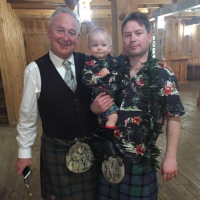
I’m Jim Shankland the script writer of this tale - a tribute to my mother Nancy Donn. The recording is an extract from my family story ‘Just Passing Through.’ Thanks to the principal narrator my son James Donn Shankland and to Ian Leith for narrating the John O’Groats articles. Thanks also to Wick Voices for editing and producing the podcast and making it publicly available.
Jim Shankland
 Contributors
 Photos





 Harry Gray