

The Bank Row bombing: It really destroyed the family
Recorded 2 years ago

 About this recording
John Mackenzie tells how four members of his family lost their lives when a German plane dropped two bombs in Wick’s Bank Row on July 1st, 1940. They were his great-grandfather, grandfather, grandfather’s sister and grandfather’s sister-in-law: Robert Mackenzie (71), Private Robert Mackenzie (30), Mary McTavish (44) and Isobel Mackenzie (25), who were all in the family tailor’s business at the time. Mary Steven (44), who was working there temporarily, also died.
“It’s a sad story, it really is,” John says. “My mother [Morna] was only six weeks old when her father was killed in the bombing.
“My grandfather’s brother David… his wife Isobel was pregnant when the bombs fell, so he didn’t only lose his wife, he lost his child as well. She was a matter of seven or eight weeks away from full term.”
John is chairman of the community group that looks after the Bank Row memorial garden, Second World War Air Raid Victims - Wick. The garden had its official opening in 2010 after many years of fundraising and groundwork by the committee and others in the community, supported by generous local businesses.
It was created as a place of remembrance for 18 people who lost their lives in two air raids. Fifteen died in the Bank Row bombing and three more were killed in Hill Avenue on October 26th the same year.
John mentions two of those who lost siblings in the Bank Row attack, Elsie Cormack and Alister Wares, and explains how the memorial garden’s daisy motif was inspired by the fact that one of Elsie’s younger sisters loved to make daisy chains.
“The whole point of the garden is that it’s for anybody to go to, and it’s a place of reflection and contemplation,” John explains. “With the harbour and all the traffic going back and fore, and all the noises, when you’re sitting there you don’t hear it; you don’t hear a thing. It’s just this quiet corner that is so peaceful. And it makes you think… Well, it wasn’t peaceful on July 1st, 1940. Two bombs fell and there were so many people killed. It’s just a place where I can go and reflect.”
John served in the Royal Army Ordnance Corps. “It was going to be a career for me, my whole life, but unfortunately I had to be medically discharged after two-and-a-half years,” he says. “My army career was exciting in a lot of ways because everything that could go wrong with me would go wrong.”John is a committee member of the Wick, Canisbay and Latheron branch of the Royal British Legion Scotland.
Donations towards the upkeep of the Bank Row memorial garden are always welcome. Email alan@wickvoices.co.uk and the Wick Voices team will pass on any messages to the memorial garden committee.
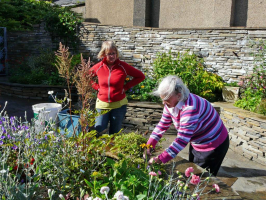
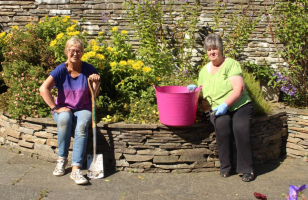
The photos in the gallery include one from the Johnston Photographic Collection (held by the Wick Society) showing the destruction in Bank Row in the aftermath of the bombing in July 1940. Others show the memorial garden at various stages of its development, including the official opening in 2010.
 Contributors

 Photos










 Harry Gray


